How Worn Suspension Parts Can Make Alignment Difficult

A wheel alignment can correct important steering and tire-angle settings, but the alignment itself depends on the suspension being in good mechanical condition. If ball joints, tie rods, control arm bushings, wheel bearings, or other components are worn, the wheels may not stay in the position the technician sets.


That is why some vehicles continue pulling, wearing tires unevenly, or developing an off-center steering wheel even after an alignment. In those cases, the problem may not be the alignment machine or the adjustment. It may be worn suspension or steering components underneath the vehicle.

Close-up of a car’s front wheel and muddy tire on a dirt road, with a red mud flap visible.

Alignment Depends on Stable Components

Wheel alignment involves adjusting angles such as toe, camber, and caster so the tires contact the road properly and the vehicle tracks as intended.


Those measurements assume the suspension and steering parts holding the wheels in place are solid.


If a component has excessive play, the wheel can move slightly when the vehicle accelerates, brakes, turns, or hits a bump. That movement can change the effective alignment while the vehicle is being driven.


A vehicle may therefore measure correctly in the shop but behave differently on the road.
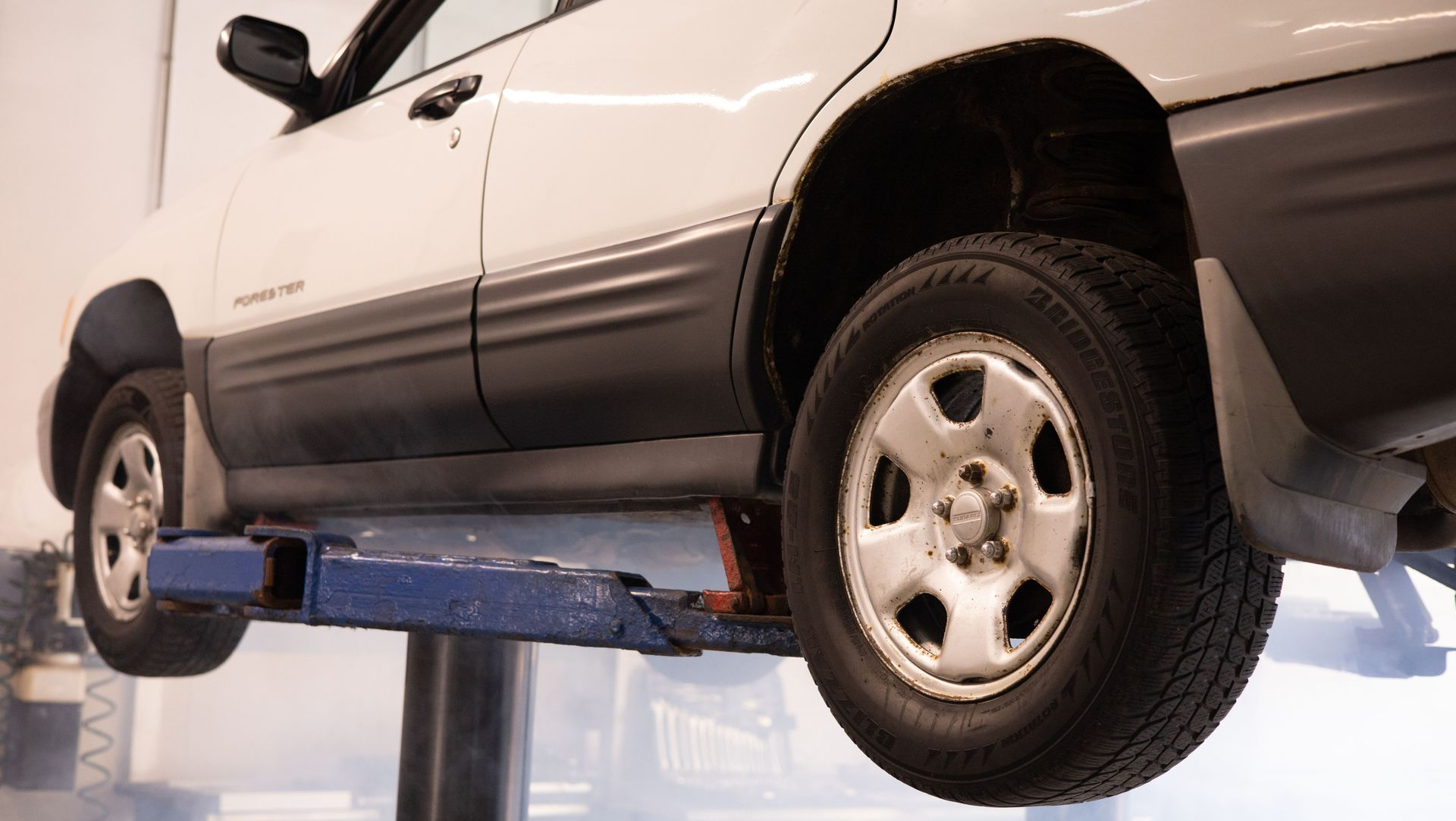
SUV lifted on a blue car lift in an auto shop, viewed from the side

Worn Tie Rods Can Affect Toe

Tie rods connect the steering system to the wheels and play an important role in controlling toe alignment.


If a tie rod end becomes worn, the wheel may develop unwanted side-to-side movement. That can cause wandering, inconsistent steering, or rapid tire wear.


A technician may be able to adjust the alignment temporarily, but if the worn component allows continued movement, the setting may not remain accurate.


Tie rod problems should generally be corrected before a final alignment is performed.

Mechanic in red shirt working under a raised car in an auto shop

Ball Joints Can Affect Wheel Position

Ball joints allow suspension components to move while keeping the wheel properly located.


As they wear, excessive movement can develop. Depending on the suspension design, that looseness may affect camber, steering response, and tire contact with the road.


Drivers may notice uneven tire wear, clunking noises, vague steering, or changes in handling.


Because worn ball joints can also become a safety concern, they deserve attention beyond their effect on tire alignment.

Red car driving on a cable-stayed bridge with city skyscrapers in the background

Control Arm Bushings Can Shift Under Load

Control arm bushings are designed to allow controlled suspension movement while keeping components positioned correctly.


When bushings deteriorate, the control arm may move farther than intended during braking, acceleration, or cornering.


That can cause alignment angles to change dynamically while driving.


This type of problem may be especially frustrating because the vehicle can feel different depending on speed, road conditions, or whether the brakes are being applied.


Wheel Bearings Can Create Similar Symptoms

A worn wheel bearing can allow unwanted movement at the wheel hub.


That looseness may contribute to irregular tire wear, noise, vibration, or steering changes. In severe cases, it can interfere with accurate alignment measurements.


Because several suspension and steering problems can produce similar symptoms, a mechanical inspection is often important before assuming that an alignment adjustment alone will solve the issue.

Close-up of a yellow motorcycle shock absorber spring with a black mount and gray body panel

New Tires Can Wear Quickly on Worn Suspension

Installing new tires without correcting worn suspension components can become expensive.


If the wheel is moving because of a damaged bushing, loose tie rod, or worn ball joint, the new tire may begin developing uneven wear almost immediately.


Once an abnormal wear pattern develops, correcting the suspension and alignment cannot restore the tread that has already been lost.


Having the steering and suspension inspected when unusual tire wear is present can help protect a new set of tires.

Classic silver car lifted on a garage hoist, front wheel removed for repair

Why Pre-Alignment Inspection Matters

A proper alignment service should begin with checking whether the vehicle is mechanically capable of holding an alignment.


That may include inspecting steering components, suspension joints, bushings, tire condition, wheel bearings, and other relevant parts.


If excessive looseness is found, repairing the worn component first usually makes more sense than attempting to align the vehicle around the problem.


Once the suspension is stable, the alignment can be adjusted more accurately.


Fix the Cause of Uneven Tire Wear

Alignment settings are only part of the system that keeps tires tracking correctly. Worn tie rods, ball joints, bushings, wheel bearings, and other suspension components can allow the wheels to move after an alignment has been performed.


Raymond’s Tire Shop provides tire service, balancing, wheel alignment, flat repair, wheels, and tire inspections. If your vehicle continues pulling, wandering, or wearing tires unevenly after an alignment, contact Raymond’s Tire Shop. A closer inspection can help determine whether worn steering or suspension components are preventing the vehicle from holding the correct alignment.

Red coilover shock absorbers with black mounts arranged on a dark surface.
Car parts and tools on a tiled floor beside a vehicle wheel, suggesting repair work
Black air suspension spring bag mounted on a vehicle’s wheel assembly in a workshop close-up
Close-up of a car tire on wet pavement, with a white vehicle body in the background
Mechanic in dark coveralls inspecting a raised car in an auto shop garage
Close-up of an off-road vehicle’s suspension coil spring and tire in red and gray.
Green neon-lit car wheel under a corrugated metal roof at night
August 28, 2026
When a tire repeatedly loses air but there is no obvious nail, screw, or visible puncture, the problem may be where the tire meets the wheel. This area is known as the tire bead, and a poor seal between the bead and the rim can allow air to escape gradually. Tire bead leaks are a common cause of slow pressure loss. Understanding why they happen can help drivers recognize when a tire needs professional inspection rather than repeatedly adding air. What Is the Tire Bead? The bead is the reinforced inner edge of the tire that sits tightly against the wheel rim. When a tire is properly mounted and inflated, air pressure helps hold the bead securely against the wheel, creating an airtight seal. If that sealing surface becomes damaged, dirty, corroded, or distorted, a small pathway can develop for air to escape.  Because these leaks may be very small, the tire can lose pressure over several days or weeks rather than going flat immediately.
August 23, 2026
A pothole impact can feel like a quick jolt, but the forces involved can affect several parts of the tire and wheel assembly. The faster the vehicle is moving, the less time the tire has to absorb the impact. In some cases, the damage is immediately obvious. In others, problems may not become noticeable until later. Raymond’s Tire Shop helps drivers inspect tires, wheels, balancing, and alignment after hard road impacts. Understanding what can happen during a pothole strike can make it easier to recognize when a tire needs professional attention. The Tire Is Compressed Extremely Quickly When a tire drops into a pothole and strikes the far edge, the sidewall and tread can be compressed between the road and the wheel. Tires are designed to flex, but a severe impact can exceed what the internal structure can safely absorb.  The risk can be greater when tire pressure is too low because there is less air cushioning between the road surface and the wheel. However, even a properly inflated tire can be damaged by a deep pothole at sufficient speed.
August 16, 2026
Tires are one of the most important safety components on any vehicle because they are the only parts that maintain direct contact with the road. As tires wear, their ability to grip pavement, channel water, and respond predictably can gradually decline. The challenge is that unsafe tire conditions are not always obvious until performance has already been affected.  Raymond’s Tire Shop helps drivers evaluate tread wear, tire damage, pressure issues, alignment problems, and other conditions that can affect tire safety. Knowing what to look for can help you recognize when a tire needs professional attention or replacement.
August 7, 2026
Most drivers think of tires simply as the round rubber components that allow a vehicle to roll down the road. In reality, tires are sophisticated pieces of engineering that perform several essential functions every time a vehicle is in motion. They support the weight of the vehicle, transmit steering and braking forces, absorb road irregularities, and maintain traction in changing driving conditions. Every acceleration, turn, and stop depends on these four small contact patches where the tires meet the road.  Understanding the primary functions of a tire helps drivers appreciate why routine maintenance and timely replacement are so important. Raymond’s Tire Shop helps customers choose quality tires and maintain them properly so their vehicles continue to perform safely and efficiently throughout the life of the tire.
July 31, 2026
Understanding how your tires interact with wet pavement is one of the most important parts of safe driving. While most drivers know that rain can make roads slippery, fewer understand how hydroplaning occurs or why it can cause a vehicle to suddenly lose traction. Knowing what causes hydroplaning—and how proper tire maintenance can reduce the risk—can help you stay safer during wet weather.  At Raymond’s Tire Shop, we believe that informed drivers make safer decisions. Keeping your tires in excellent condition is one of the best ways to improve vehicle performance when road conditions are less than ideal.
July 23, 2026
Your tires are one of the hardest-working components of your vehicle. They provide traction, support your vehicle’s weight, absorb impacts from the road, and help you maintain control in a wide range of driving conditions. Because they experience constant wear, replacing tires is an expected part of vehicle ownership. However, proper maintenance can help maximize their lifespan, improve performance, and save you money over time. Many of the factors that affect tire longevity are within a driver’s control. By following a few simple maintenance practices, you can help your tires wear more evenly and perform as intended throughout their service life.